Back in August, X erupted over a viral post lamenting the price of a $20 burrito.
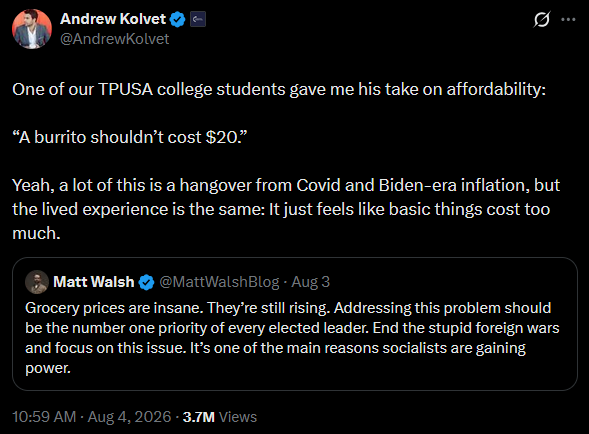
The reactions were predictable – older millennials and Gen Xers mocked Gen Z for not being frugal enough and urged them to cook at home.
There is some truth to that. After all, the only $20 burritos I could find were at an airport or UberEats. But arguing over whether a burrito actually costs $20 misses the point entirely. The $20 burrito is an analogy for the out-of-control rise in the cost of living that Americans are experiencing.
According to the Department of Labor Statistics, “Food at Home” prices are up about 5% since the start of 2024 and were 2.2 percent higher in August than a year earlier. That is well below the jump since 2020, when the same index rose about 32 percent amid the inflation surge, which research has found was fueled in part by federal spending in response to the COVID-19 pandemic.
A new administration can reasonably point to what it inherited for a while. After a year, it is fair to ask which of its own choices are still pushing costs up.
People point to the war in Iran, and it is undeniably having a significant effect on gas prices. Before the US and Israel struck Iran at the end of February, gas averaged just under $3 and crude was about $67. Now crude is about $90 and regular gas is about $4.37, with diesel above $6.30. The war in Iran and the closure of the Strait of Hormuz cut off a fifth of the world’s oil, and the effects are being felt all around the country.
But the war doesn’t explain everything. In fact, it can make it easier to overlook the policy choices that are still making everyday goods more expensive.
For example, the cost of steel, aluminum and copper face 50% tariffs on the full value of the product, with 25 percent on derivatives, with medium and heavy trucks facing an additional 25%. Lumber carries a 10% tariff on top of anti-dumping and countervailing duties that pushed the combined rate on Canadian softwood above 35 percent last year.
When it comes to gas, the war is easy to see. Oil gets more expensive, so gas gets more expensive.
Tariffs work differently. They attack links in the chain of commerce rather than one finished product. A duty on steel, aluminum, or copper raises the cost of the metal that goes into trucks, appliances, and building materials. A duty on lumber raises the cost of building homes. A duty on medium and heavy trucks raises the cost of moving food, furniture, and supplies. None of that shows up the next morning as a single tariff line on a receipt. But it’s there, and eventually shows up in the prices consumers pay.
The administration’s own response to higher energy costs actually provides a useful example of how these restrictions work. Earlier this year, the administration suspended the Jones Act to blunt the higher fuel prices caused by the war in Iran. The law requires goods moved between U.S. ports to travel on ships that are built, owned, flagged, and crewed in the United States. The waiver, first issued in March and later extended, let foreign ships carry oil and fuel between American ports.
Like a tariff, the Jones Act restricts access to cheaper foreign competition on domestic routes. By not enforcing it, the administration cut a freight penalty valued at about $100 million to $110 million. That will not undo the war. It shows the restriction was a cost, and that dropping it made moving American fuel cheaper.
The war in Iran will end. Oil prices will come down. The Jones Act is more than 100 years old. These tariffs, unless repealed, could stick with Americans for generations. If we don’t stop them, one day it won’t just be a $20 burrito at the airport. It will cost $20 to make one at home.
I don’t dare guess how much it will cost to eat out.